
Differentiate for the future: why sovereign AI is a must for Australian financial institutions
Key Takeaways
- As AI in financial institutions moves from useful to essential, the economic pressures that created modern hybrid cloud strategies will show up – faster and harder than pre-AI workloads.
- AI is becoming essential for productivity in finance, but only 1% of financial institutions are fully AI-mature, indicating a significant gap in integrating AI into workflows.
- A move towards sovereign AI is crucial for compliance and cost predictability, with institutions needing to control sensitive data while leveraging AI's benefits .
Cloud repatriation set the precedent – and hybrid infrastructure is now the norm. Now, as AI becomes table stakes, sovereign AI offers every financial institution a competitive advantage – should yours choose to take it.
Most financial institutions have already had the cloud repatriation conversation. As digital workloads kept scaling, public cloud costs became harder to justify. Organisations that had built their operations around public cloud infrastructure suddenly found themselves overexposed. Alongside cost blowouts, cloud security and compliance concerns have seen institutions move from “cloud-first” to a “cloud-smart” hybrid strategy. Workloads that need flexibility and instant scalability stay in public cloud. For everything else, especially workloads that can’t leave Australian jurisdiction, private environments offer performance and control in equal measure.
Now, AI is on the same trajectory. Right now, public cloud makes sense for AI deployments. It’s flexible, scalable and low-commitment, making it perfect for experimentation as AI strategies take shape. But as AI moves from useful to essential, the economic pressures that created modern hybrid strategies will show up – faster and harder than pre-AI workloads.
Before AI becomes embedded in financial institutions’ workflows, IT leaders must confidently answer these three questions: “What works best in public cloud? What needs to stay private? Who’s making that call?”
That’s not a future problem anymore. Advancements in AI capability have made sovereign AI viable at scale. And knowing when to deploy it will be what differentiates financial institutions in an AI-first future. Here’s why, and how:
“AI presents great opportunity for productivity and efficiency, and failing to embrace AI may put businesses at a strategic disadvantage.”
-
-
-
- Therese McCarthy Hockey, APRA (from APRA Letter to Industry on Artificial Intelligence (AI), April 2026.
-
-
AI in financial services is now about execution, but almost all financial institutions aren’t there yet. According to McKinsey research, just 1% of companies describe themselves as “AI-mature”. They define an organisation as AI-mature when AI is fully integrated into workflows and drives substantial business outcomes. The institutions that can move fastest are the ones aligning AI use cases to stronger data flow, tighter governance, clearer ownership and ultimately, ROI.
According to ADAPT’s 2026 financial sector outlook, AI is scaling fastest in fraud detection, compliance support and cyber security. That’s not by accident. Those are the use cases where data governance is already mature and outcomes are measurable. The highest-value use cases – product and pricing decisions, strategic decision support and sales enablement – are slower out of the gate. Half of financial institutions report no activity in using AI for product and pricing decisions, Nearly half report no activity in augmenting strategic decision making. This isn’t a technology problem anymore – AI models are more than capable of helping humans with these things. It’s a data access problem, created by the infrastructure constraints financial institutions should be itching to solve.
AI transformation will take some time. AI touches every area of the business, and genuine transformation means empowering teams to redesign workflows without fear of data privacy and compliance headaches. It also means justifying the ongoing cost. No CFO is going to sign off on highly unpredictable AI expenses with no get-out clause. Nor should they – according to The State of AI Cost Governance report, just 15% of companies can forecast AI costs within ±10%.
Yet, these are the very problems that will surface if AI maturity is built on today’s AI stacks.
Three distinct pressures are pushing financial institutions’ AI strategies past the point where today’s AI technologies hold up. They are:
- Cost and control.
- The regulatory environment.
- Competitive risk.
None of these trends are new, AI-native challenges. They’re the same pressures that create modern hybrid cloud environments. But like the organisational structure itself, they’re amplified by AI.
One of AI’s key value propositions is its potential cost-efficiency gains. At least, that’s the message many financial institutions would like to get across if recent HR trends are anything to go by. According to Gartner, executive teams at financial institutions are leaning into automation, slowing headcount growth to 2% as AI budgets surge. Of course, to realise AI’s ROI, the workforce must evolve. That means reskilling technical staff into financial services domain experts who can connect AI innovation to business goals and outcomes.
But if you’re doing this to save money, what happens when the numbers don’t add up? That’s the uncertainty facing financial institutions right now. Predictable labour costs are being replaced by highly unpredictable AI compute costs. Hyperscaler GPU pricing is volatile and usage-based by design, and AI training on member data is particularly cost-intensive and hard to forecast. Despite the cost per token falling sharply since 2022, the volume of data being processed is growing faster. So, the token bill only goes one way: up, which makes future cost certainty and therefore predictability, extremely hard. By moving forward on the current infrastructure model, the risk becomes two-fold. Usage costs climb, and data egress burns a hole in your technology budget.
As models, providers and pricing shift and your institution wants to switch (and it will, eventually) high switching costs also become a problem. If you think an organisational restructure involving people is costly and complex, wait until you have to do it with AI agents.
When AI workflows become an institutional dependency, you risk losing control of how much key business processes cost. Try telling your CFO that.
Regulatory environment
Compliance has always been the loudest argument against moving fast on AI. But as Australia moves toward AI maturity, compliance obligations are becoming clearer, even as they continue to evolve.
The instruments shaping AI in financial services are in force, dated and stacking.
The Financial Accountability Regime (FAR) is fully in force across banking, insurance and superannuation. Fall foul of it, and personal civil penalties for accountable persons can go up to AU$1.565 million per contravention. The Privacy Act’s Automated Decision Making (ADM) reforms commence on 10 December 2026.
Mandatory AI guardrails are out for industry consultation, with responses expected through 2026 and 2027. And finally, the Australian Government’s National AI Plan was released in March 2026 – and explicitly calls for sovereign data alignment.
The below table outlines these pressures in more detail.
The data sovereignty and regulatory landscape for AI in financial services
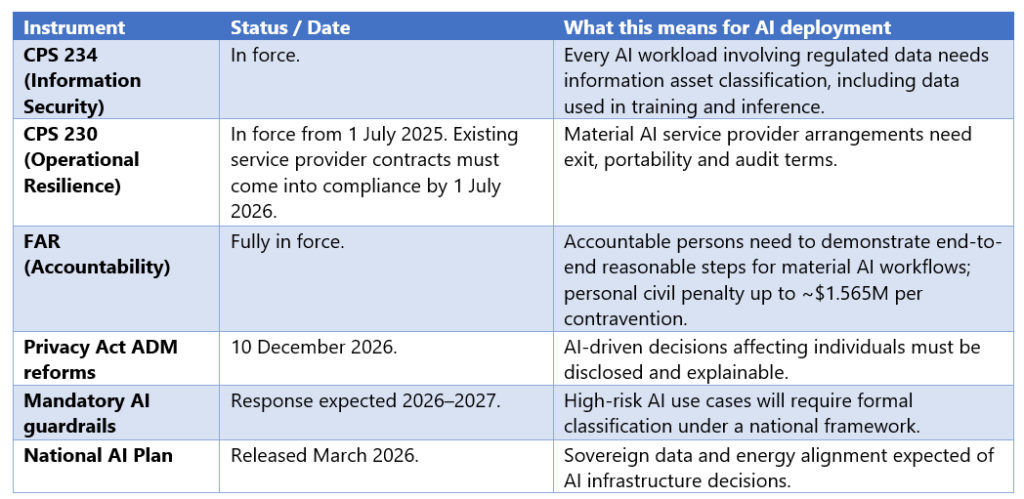
Read individually, each instrument is manageable. But together, they describe a regulatory environment that’s already incompatible with cloud-only AI deployment for any workload involving regulated data.
APRA’s Letter to Industry on Artificial Intelligence (AI) clarifies the regulator’s expectations. AI governance gaps will attract supervisory action and, where necessary, enforcement. Read that between the lines, and you’ll understand that APRA now sees AI as just another tool. It’s no longer a fast-moving, emerging technology with an uncertain future.
The AI lifecycle risk
An AI workload moves through several stages between data collection and the moment a decision is logged. Data preparation. Training or fine-tuning. Prompt construction. Inference. Response. With current public cloud and Microsoft-stack deployments, only data collection and audit logging sit inside your institution’s controlled perimeter. Every stage in between runs on infrastructure your institution doesn’t operate. Long-term, this is an unacceptable risk.
Each of those stages is a CPS 234 information security exposure point. That’s not all. Several are Privacy Act exposure points under the ADM reforms. The contractual arrangements covering them need to satisfy CPS 230’s material service provider requirements by July. And under FAR, the accountable person responsible for each material AI workflow must be able to demonstrate reasonable steps end-to-end. This, of course, includes the stages currently sitting outside the institution’s operational control.
This is the regulatory environment FSIs are operating in right now. And the gap between what current AI deployments can demonstrate and what regulators will require is widening. The institutions still treating compliance as the unresolved question are working on last year’s problem. The obligations that exist today provide enough clarity to help you navigate the AI landscape. The bottleneck, if one exists, is your response.
Competitive risk
Hyperscalers’ innovation sounds like an advantage, until it becomes a dependency that blows your budget and makes regulatory compliance impossible.
The result is a conservative institutional environment that defeats the purpose of AI adoption in the first place. Risk and compliance teams say “don’t put sensitive data in it.” Leadership gatekeep access and tightly governs who can use AI, when and for what purpose. Eventually, this will see AI only permitted for the lowest-risk, lowest-value use cases. Worse still, vendor lock-in maintains that status quo.
This isn’t a good place to be now, let alone in 2028, when, per Gartner, 95% of organisations will have integrated generative AI into daily operations.
By then, the financial institutions that solved the infrastructure problem will have a structural advantage. Through cost-efficient, compliant proprietary AI, financial institutions can confidently activate every use case.
Customer tolerance for inefficiency is already low. So, when it comes to AI capabilities, the gap between the “haves” and “have nots” will have genuine commercial impact.
That’s the case for sovereign AI.
AI and the future of financial services
In financial services, some workloads will never be safe on public AI. Compliance pressures have now made that clear, and cost pressures reinforce it.
As open-source models (such as Llama and Mistral) improve, the business case for sovereign AI continues to build.
If you haven’t thought about private AI, now’s the time to do so. Delay the inevitable, and industry leaders will solve the problem for you – leaving you to play catch-up. That won’t put you out of business, but it won’t win you many new customers or investors either.
So, what does an AI stack anchored by private AI look like? The answer’s still hybrid.
Public cloud’s still the right home for elastic workloads, burst capacity, developer tooling and general compute on non-sensitive data. The economics work where flexibility matters more than control. The general-purpose AI layer stays too. Microsoft and the M365 ecosystem can add value right away for common use cases: Copilot, productivity tooling and pre-built models for general tasks. For workloads where the data isn’t sensitive and the model doesn’t need to be yours, this layer does the job well.
For the workloads that can’t safely sit in either of those environments, sovereign AI should come sooner rather than later. This means sensitive model training on member data running on infrastructure your institution controls, with full auditability and explainability to satisfy FAR obligations. It means proprietary IP stays in-house, alongside the competitive advantage built on top of it.
And for sustained, predictable workloads, dedicated infrastructure delivers 30-50% TCO savings compared to consumption-based billing. That’s cost predictability the current model can’t provide.
Ultimately, sovereign AI keeps your institution in control over what comes next. In an era where financial institutions are defined by their AI capabilities, it could be the difference between longevity and legacy.