
Beyond the buzzword: Why SASE is now essential for modern business security
Key Takeaways
- As traditional VPNs are increasingly failing to meet security and performance needs, Secure Access Service Edge (SASE) adoption is booming.
- SASE combines critical security and networking functions, including Zero Trust access, to address modern technology requirements.
- Interactive provide end-to-end SASE implementation. From initial assessment to deployment, management, and optimisation, Interactive delivers every component of a tailored Managed SASE solution.
The global Secure Access Service Edge (SASE) market is on track to nearly triple in size, growing from USD $15.5 billion in 2025 to over USD $44 billion by 2030.
According to Modor Intelligence, the SASE market is valued at USD 12.94 billion in 2025 and is forecast to reach USD 32.60 billion by 2030, advancing at a 20.29% CAGR.
Asia Pacific is expanding at 22.40% CAGR. Governments mandate data residency, pushing firms toward platforms that enforce location-aware policies.
Certainly, that’s not just growth, and not just a buzzword. In fact, it’s now mission-critical, and a signal that organisations worldwide are rapidly overhauling how they secure users, data, and applications in a hybrid, cloud-first world.
Indeed, SASE has moved from an emerging concept to an operational necessity. So how has that happened?
For starters, remote and hybrid work have become permanent fixtures, SaaS adoption has exploded, and legacy VPNs are showing their cracks, leaving businesses exposed to unacceptable risks.
But there’s more. This article explains why SASE matters now more than ever, exploring how it addresses these VPN limitations, powers Zero Trust, and aligns and meets the realities of SaaS adoption and hybrid and cloud demands, all supported by proven data.
If anything, now is the time to understand not just what SASE is, but what it delivers, and why you need a dedicated partner to guide you through it.
Why businesses today need SASE
VPN limits in a cloud world
Let’s face it: Traditional VPNs were once a stalwart of secure remote access, but they’re showing their age.
Let’s consider some numbers: More than half of enterprises (56%) experienced at least one cyberattack exploiting VPN vulnerabilities in the past year, and 41 % reported suffering two or more such attacks, according to a 2024 global VPN risk study. This underlines how easily VPN weaknesses can be exploited.
According to the Australian Cyber Security Centre, “malicious actors frequently use techniques such as virtual private networks (VPNs), anonymisation services, and compromised infrastructure to conceal their identities and location.”
Technical flaws are widespread, too: estimates suggest around 46,000 VPN servers are vulnerable to hijacking. Clearly, legacy VPNs fall short in reliability, performance, and security.
On top of that, downtime and reliability issues further amplify the risk. VPN overloads and unplanned outages were responsible for approximately 12 % of network disruptions in 2025, frequently creating exploitable gaps in defences and impacting business operations.
Combine that with the everyday pain points businesses encounter:
- Split tunneling challenges, which expose internal traffic to the public internet.
- High latency, especially when routing through centralised VPN hubs.
- Complex, unwieldy policy configurations that are difficult to manage or scale.
- Poor user experience for hybrid staff, who often face inconsistent access and slow performance, especially when switching between office and remote environments.
Clearly, legacy VPNs are falling short, and not just in security, but also in performance, usability, and resilience.
Drivers: Cloud, SaaS & hybrid work
Undoubtedly, the digital workplace is evolving fast. By 2025, 85% of software usage is expected to be SaaS-based, up from significantly lower figures just years ago. Gartner also highlights that 85% of organisations will adopt a cloud-first strategy by 2025.
What’s more, organisations now rely on an average of 371 SaaS applications, while 99% of companies already use at least one SaaS platform. Additionally, the average business is now spending around $3,500 per employee on SaaS tools, according to a Forbes article.
On the workforce side, hybrid models are firmly entrenched. In Australia, 6.7 million employed people – 46 % of the workforce – work remotely at least part-time.
According to Australia’s Productivity Commission, 36% of employed Australians usually worked from home, compared to just 12% before COVID 19. Hybrid arrangements are now seen as either productivity-neutral or beneficial.
Globally, business leaders predict that by end of 2025, less than 55% of the workforce will be office-bound, while 41% of hybrid workers follow a 3 2 (office home) schedule.
Notably, this remote, cloud-first world – and cloud sprawl landscape – demands a unified, flexible security framework.
Zero Trust & SASE: A perfect match
Enter Zero Trust, which is now not an option, but a necessity. In fact, it’s a core security philosophy that assumes no user, device, or application should be trusted by default. Every connection must be explicitly verified before access is granted, whether it originates from inside or outside the network.
And that’s why SASE provides the perfect delivery model for this approach. By converging networking and security into a cloud-native framework, SASE enables:
- Explicit access: Users are granted only the minimum access necessary to perform their role, reducing the attack surface and containing potential breaches.
- Identity-aware routing: Access decisions are based on the user’s identity, device posture, location, and risk profile, ensuring the right person connects to the right resource in the right way.
- Continuous validation: Authentication isn’t a one-and-done event. SASE enforces real-time checks throughout the session, re-authenticating and adjusting access dynamically if risk factors change.
Gartner estimates that more than 60% of organisations will adopt Zero Trust principles by 2025, making SASE a complementary technology, but also a foundational platform for implementation. Together, they deliver a security posture that is adaptive, context-driven, and resilient to modern threats.
Australia’s surge in Zero Trust adoption
Australia is quickly moving from treating Zero Trust as a catchphrase to embedding it as a mandate. The federal government is leading the way: under the 2025 Protective Security Policy Framework (PSPF), all Commonwealth agencies must adopt Zero Trust principles, embedding continuous verification and least-privilege access across systems and people. The Australian Signals Directorate has also released new guidance on “modern defensible architectures,” reinforcing Zero Trust as a cornerstone of the nation’s cyber resilience strategy.
This top-down momentum is mirrored in the market. According to Grand View Research, Australia’s Zero Trust security market is worth more than USD 520 million in 2024 and is forecast to triple to USD 1.6 billion by 2030, growing at a 20.6% CAGR.
The sectors driving this surge are those with the most at stake. Government and public sector agencies are at the forefront due to regulation. Financial services and banking are rapidly adopting Zero Trust to protect vast customer data stores and meet compliance demands.
Meanwhile, healthcare and critical infrastructure providers are embracing Zero Trust to safeguard sensitive records and ensure operational continuity amid escalating ransomware threats. Together, these sectors are setting the tone for broader enterprise adoption across Australia.
Increased speed & visibility
By converging networking and security into a cloud-native delivery model, SASE removes the friction that slows users and systems down. Applications launch faster because traffic is routed optimally through distributed points of presence rather than backhauling to a central data centre. The result: a consistent, high-quality experience whether users are in the office, on the road, or working from home.
Indeed, the benefits go beyond performance:
- Consistent user experience: Employees get the same secure, responsive access to business applications anywhere, on any device.
- Reduced hardware spend: Cloud-delivered security means less reliance on expensive on-premises appliances, lowering both capital expenditure and ongoing maintenance costs.
- Simplified compliance reporting: Centralised policy management and unified logging make it easier to generate the reports needed for regulatory audits, while maintaining full visibility into user activity.
- Improved visibility and access speeds: Network and security telemetry are consolidated, giving IT teams a single view of performance and threats in real time.
This combination of speed, reliability, and simplicity makes SASE a security upgrade, but also a productivity enabler for modern, distributed workforces.
Market momentum & analyst proof
If there’s one thing to take away it’s that SASE isn’t emerging, it’s already established. Let’s recap on some of the numbers:
Gartner forecasts the Secure Access Service Edge market to grow at a 29% compound annual rate, surpassing USD 25 billion by 2027. Adoption will be driven by a mix of single-vendor solutions and dual-vendor deployments, as organisations balance integration benefits with best-of-breed capabilities.
By 2027, Gartner predicts CIOs and CISOs will rank secure “work from anywhere” capabilities, whether supporting remote staff, branch offices, or campus networks, as a top business priority.
Additionally, Gartner says the vendor landscape will also shift. The largest SD-WAN and Security Service Edge (SSE) providers are expected to deliver fully converged, single-vendor SASE platforms , consolidating networking and security into a seamless offering.
Vendors such as Fortinet, Versa Networks, and Palo Alto Networks are prominently listed in Gartner’s Magic Quadrant for SASE Platforms, reflecting their leadership in converging networking and security into single-vendor solutions.
Those unable to deliver a compelling SASE solution will be left competing in niche, shrinking segments of the market, as enterprises gravitate toward integrated approaches that simplify operations and strengthen security.
Other forecasts, including one from Mordor Intelligence, estimates USD $12.94 billion in 2025 expanding to USD $32.60 billion by 2030 (20.3% CAGR).
These robust projections highlight investor and enterprise belief in SASE as a strategic imperative.
What SASE actually delivers
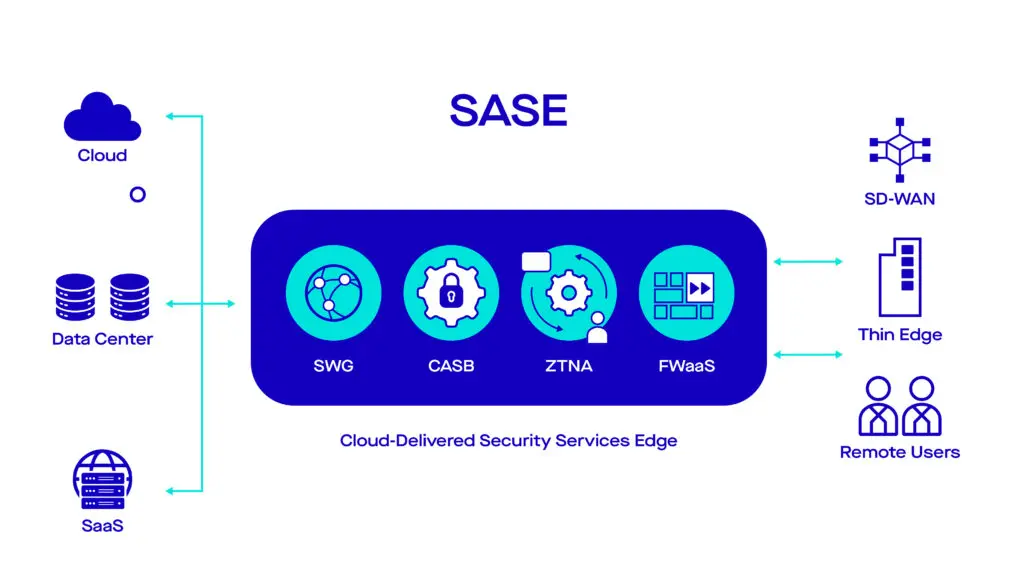
So let’s summarise what SASE actually delivers – since it’s not hype, but a holistic framework. At its core, SASE combines:
- SD‑WAN for agile, high-performance network routing
- Zero Trust Network Access (ZTNA) ensuring granular, identity-based access
- Secure Web Gateway (SWG) protecting users from web-based threats
- Cloud Access Security Broker (CASB) enforcing visibility/control over SaaS apps
- Firewall-as-a-Service (FWaaS) offering cloud-delivered firewall protections
This convergence delivers streamlined management, reduced complexity, and enhanced security and visibility across every touchpoint of user and application access.
Interactive’s managed SASE advantage
Here’s why Interactive stands out as the ideal SASE partner:
- End-to-End Service: From initial assessment to deployment, management, and optimisation, Interactive delivers every component of a tailored Managed SASE solution.
- Deep Expertise: As an Australian full-stack IT services provider committed to 100% system availability, Interactive brings unmatched technical depth and local understanding to every engagement.
- Customer-Centric Delivery: We prioritise seamless user experience, robust performance, and measurable security outcomes that align with your business goals.
With Interactive as your trusted guide, you gain a truly managed, adaptive, and future-ready approach to SASE, one that simplifies complexity while maximising value.
If you’re exploring your next steps in secure networking, get in touch with us to discuss your goals and how we can help.