
How to evaluate smart hands providers in Australia | 2025 checklist
Key Takeaways
- Selecting the right smart hands vendor is crucial for Australian organisations to ensure reliable support for IT infrastructure and minimise downtime.
- Smart hands services provide deeper, more complex support than remote hands, including the ability to troubleshoot issues onsite.
- Organisations should evaluate vendors on strict performance criteria, including: local presence, service capabilities, SLAs and technician expertise.
Smart hands are a valuable asset to any organisation that can’t afford downtime. But not just any smart hands vendor will do. To maximise your investment in smart hands and remote hands services, you need to choose a vendor that’s right for your organisation.
For Australian organisations, selecting the right smart hands services provider takes more than comparing a few quotes. After all, you’re choosing someone you’ll trust with your physical infrastructure, the beating heart of your organisation.
The problem? Every smart hands company says the same thing: they’re fast, responsive and local. That’s why you need a framework to confidently discern real operational capability from polished sales decks.
This checklist helps you do exactly that. It breaks down the essentials of smart hands service evaluation — skill sets, SLAs, coverage, and the quiet discipline that separates real engineers from “remote hands” tourists.
Smart hands vs remote hands: Understanding the difference
When considering smart hands vendors, it’s important to understand the difference between two related, yet distinct services: smart hands and remote hands.
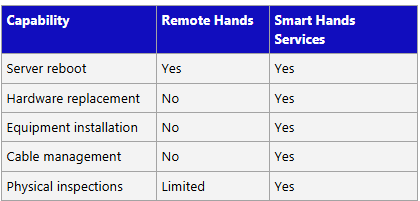
Remote hands, as the name implies, troubleshoot and fix issues remotely. They cover the basics: quick reboots, visual checks, cable tracing, swapping a component under direction. They’re the quiet workhorses of the data centre: efficient, reliable, and essential for day-to-day maintenance.
Smart hands services go deeper. Smart hands engineers are a physically present extension of your team. They provide complex services like server installation, rack and stack, and full equipment decommissioning. Good ones aren’t just following the vendor’s playbook. They have the specialised expertise to diagnose and solve problems in real time.
Most problems don’t need an engineer on site, so remote hands suffice as everyday assistance. But for the issues that do, you’ll want the right kind of help, and that’s where smart hands come in.
The difference matters. When Sydney’s Azure Australia East region went down in August 2023 after a cooling system failure, remote dashboards went dark worldwide. But once access reopened, the teams with trusted smart hands on-site were the first to confirm what survived, what didn’t, and what they needed to rebuild.
Smart hands vs remote hands comparison table:
Your Australian smart hands services vendor selection checklist
Here’s where the sales pitch ends, and the reality check begins.
Use this comprehensive checklist to rank potential smart hands vendors against the criteria that matters. That way, you’ll make an informed decision that’s vindicated every time your smart hands team fix a data centre issue before it can turn into a crisis.
Core service capabilities:
Your smart hands provider should be able to handle every part of your infrastructure lifecycle — installation, maintenance, testing, and retiring — with zero hand-offs or guesswork. If they can’t cover all core services, you’ll feel it when things go wrong.
Verify the provider offers the following essential services:
- Server Installation Services: Provide complete deployment, configuration, and functional testing of new servers.
- Rack and Stack Services: Perform physical installation of equipment with a structured layout and clear labelling.
- Network Infrastructure Support: Deliver network cabling, switch and router installation, and connectivity testing.
- Equipment Testing Services: Conduct diagnostics and pre-deployment performance checks to verify reliability.
- Hardware Support Services: Replace components, apply firmware updates, and perform hardware upgrades.
- Break-Fix Services: Provide rapid-response emergency repair and hardware restoration.
- Equipment Decommissioning: Carry out secure removal, data sanitisation, and compliant disposal in line with Australian data protection standards.
- Cross-Connect Services: Manage carrier, network, and equipment interconnections for seamless operation.
- Data Centre Maintenance Services: Deliver preventative maintenance and continuous system care to maximise uptime.
- NBN Connectivity: Demonstrate proven experience in configuring and supporting NBN-connected environments.
- Telco Relationships: Maintain strong working relationships with all major telecommunications providers, including: Telstra, Optus and Vocus.
- Data Centre Partnerships: Operate in partnership with leading data centre operators such as NextDC, Equinix, Interactive, CDC Data Centres, and AirTrunk.
Geographic coverage & local presence
If downtime hits, your team and customers won’t wait for travel time. A smart hands vendor’s local presence means faster fixes. To make this an operational reality, you need technicians who are already in your city, cleared for your sites and already familiar with your data centre procedures.
- Local technicians based in your city (not interstate fly-ins).
- Authorised access to your data centres and major facilities.
- Coverage at key Australian facilities:
- Sydney: Equinix SY3-SY6, NextDC S1–S3, Global Switch, Interactive.
- Melbourne: NextDC M1–M2, Equinix ME1-ME4, Digital Realty, Interactive.
- Brisbane: Equinix BR1, Polaris, NextDC B1–B2, Interactive.
- Perth: Equinix PE1
- Local backup resources within the same metro area.
- No travel surcharges for metropolitan coverage.
- Awareness of local data centre procedures and operator requirements.
- Alignment with AEST, AEDT, ACST and AWST time zones.
When downtime costs millions, minutes count. Local technicians cut response times, remove interstate delays, and keep support aligned to your operating hours. It’s the difference between immediate action and waiting for a flight.
Smart hands SLA, response times & availability
Your smart hands vendor’s Service Level Agreement (SLA) is your safety net. You should expect guaranteed response times, 24/7 coverage, and backup techs ready to go when the first call fails. Anything less is a gamble where catastrophic downtime is the odds-on favourite.
Here’s what to ensure is included in your SLA for the highest level of operational assurance:
- 24/7/365 smart hands support: true round-the-clock Australian coverage.
- Guaranteed response times: 2–4 hours for metro areas (verify site specifics).
- After-hours support: Evenings and weekends without premium surcharges.
- Australian public holiday coverage: Melbourne Cup, Queen’s Birthday (state variations).
- Emergency escalation protocols: Defined contact hierarchy and response flow.
- Backup technician availability: Within the same city for redundancy.
- Weather and disaster planning: Coverage during bushfires, floods, or storms.
- Long weekend coverage: Australia Day, ANZAC Day, etc.
- Summer period coverage: Operational assurance for the quiet (yet still crucial) December–January period.
Smart hands technician expertise & certifications
The quality of your smart hands service is only as strong as the technicians on site. Certified, background-checked professionals ensure every touchpoint — from cabling to critical replacements — meets Australian standards and vendor expectations.
- Confirm the provider uses Australian-based certified professionals, not offshore coordinators who subcontract local technicians.
- Verify that technicians hold relevant certifications, such as BICSI or vendor-specific credentials from Cisco, NetApp, Dell, or HPE.
- Check that all staff have Australian electrical licences where required for on-site work.
- Ensure the team demonstrates multi-vendor expertise, with experience handling your specific hardware brands.
- Confirm the vendor has a proven Australian presence, including years in operation, client testimonials and client retention metrics.
- Confirm that all technicians have current Australian police checks and background verification.
- Assess whether they follow standardised procedures and quality-control processes to reduce human error.
- Ask about ongoing training programs to confirm technicians stay current with technology and compliance changes.
Security & compliance
Every cable run and decommission carries compliance risk. Your provider should meet the same security, privacy, and governance standards you do — because lapses in their process can become your liability.
- Verify that the provider complies with the Australian Privacy Principles (APPs) under the Privacy Act 1988 (Cth).
- Ensure they have a clear data sovereignty policy guaranteeing Australian data stays within Australia.
- Confirm that they maintain current Australian insurance coverage, including public liability and professional indemnity insurance.
- Ask for proof of ISO 27001 (Information Security) and ISO 9001 (Quality Management) certifications.
- For public sector organisations: Check for IRAP assessments or clearances if they support government agencies or sensitive clients.
- Review their secure data destruction processes to ensure compliance with Australian disposal standards.
- Make sure NDAs and confidentiality agreements are standard in all the vendor’s engagements and contracts.
Pricing & contract terms: Australian commercial considerations:
When costs are involved, no one likes surprises. Transparent, GST-inclusive pricing and flexible contract terms protect you from hidden fees and shifting conditions — ensuring every dollar buys real coverage.
- Confirm that all pricing is quoted in AUD, GST-inclusive, and fully transparent.
- Verify the vendor’s ABN or ACN to confirm their legitimacy and Australian presence.
- Clarify whether the pricing model is hourly, per-incident, or retainer-based, and ensure it suits your support needs.
- Ensure there are no hidden fees, including travel, parking, or equipment hire charges.
- Check for contract flexibility, such as month-to-month or annual options.
- Confirm that standard 30-day payment terms apply to all invoicing.
- Ask whether the provider offers volume discounts or multi-site pricing for broader coverage.
Communication & reporting
When something goes wrong, you need answers — not radio silence. Local communication lines, real-time updates, and proof-of-work reporting are the difference between control and chaos.
- Ensure the provider offers Australian business hours support with local phone lines, not offshore call centres.
- Confirm they provide real-time status updates in Australian time zones.
- Request photo and video documentation as proof of completed work.
- Expect detailed completion reports outlining all actions taken and results achieved.
- Check that their systems integrate with your service management or ticketing platform for seamless communication.
- Ensure you have a dedicated Australian account manager who understands your organisation.
- Review the provider’s escalation procedures to confirm you can quickly raise any issues to local management.
Red flags to watch for in Australian smart hands providers
Not every smart hands company is built the same. Some have the expertise to keep your infrastructure online, others just run polished marketing campaigns that make you think they do (the best ones do both). Knowing the difference comes down to spotting the warning signs early.
When evaluating smart hands vendors, watch out for these red flags.
- No local presence: “national coverage” that relies on fly-in technicians means longer delays and higher costs. Make sure your smart hands vendor has boots on the ground in your city or state.
- Offshore help desk: if ticketing and coordination are handled overseas, expect slower responses and time zone confusion.
- Vague, commitment-free SLAs: “best effort” isn’t a commitment. It’s an excuse for mediocrity that becomes a liability when push comes to shove.
- No data centre access: vendors without pre-approved authorisations can’t act quickly when incidents occur.
- No Australian insurance: operating without public liability or professional indemnity insurance leaves you exposed.
- No ABN or ACN: This one’s self-explanatory.
- Hidden travel fees: some “metro” rates include a much smaller definition of metro, that often seem to end a few blocks away from your site. Always confirm what’s included in a vendor’s onsite travel costs.
- Very low pricing: as the saying goes, “pay cheap, buy twice”. If costs are far below market rate, something’s being cut — usually corners.
- No local references: established providers should be able to point to Australian clients.
- Limited holiday coverage: real 24/7 support doesn’t pause for long weekends or public holidays.
Essential questions to ask Australian smart hands providers
Choosing a smart hands company means verifying that their promises will hold up under pressure. These questions will help you cut through the sales pitch and uncover how each smart hands service truly operates.
Local operations
- Where are your technicians physically based in my city?
- What’s your typical response time for my specific data centre?
- Do you already have authorised access at facilities like NextDC, Equinix, or CDC?
Quality & compliance
- How do you ensure technicians follow procedures consistently? (Don’t forget this one. According to the Uptime Institute’s Annual Outage Analysis, 58% of outages are linked to procedural lapses.)
- Do all technicians hold current Australian police checks?
- Are you compliant with the Australian Privacy Principles for data handling?
Commercial
- Is all pricing quoted in AUD and inclusive of GST?
- Are there any additional travel charges within metro areas?
- Can you provide Australian client references I can speak with?
Ready to say goodbye to IT downtime? Interactive’s smart hands services connect Australian organisations with certified data centre technicians, with proven expertise and fast, reliable response times.
Choosing your smart hands services partner in Australia
Local presence is essential for maintaining control during critical incidents. You need technicians who can respond quickly onsite rather than flying in after the damage is done. They should have a strong understanding of Australian compliance and data sovereignty, particularly if your organisation operates in a highly regulated industry. Finally, before signing an agreement, always verify potential vendors’ data centre access credentials. When downtime costs millions, speed and competence are far more valuable than a low quote.
So, now you know what to look for, it’s time to put your shortlist to the test. Before and during your search, keep these steps front of mind.
- Download our printable PDF checklist for your team.
- Get quotes from three to five Australian providers that stack up against the criteria.
- Call each provider’s local clients — not the ones on the brochure.
- Meet them on-site and see how they work under pressure.
Interactive’s smart hands team is here to help you solve every tech challenge. We’re on the ground in Sydney, Melbourne, and Brisbane, ready to safeguard your IT infrastructure as if it’s our own. Because for thousands of Australian organisations, it is. We offer managed data centre and colocation services at our data centres in Melbourne, Sydney and Brisbane. Regardless of where in Australia your data centre is, our smart hands services give you the expertise to keep it running, 24/7/365.
To find out more about our smart hands and remote hands services, visit our smart hands page. Or get in touch with us for tailored solution.