
The strategic cloud retreat: Why Australian organisations are moving to private cloud
Key Takeaways
- A growing trend of cloud repatriation is emerging as organisations seek cost savings and performance optimisation.
- Key drivers for this shift include unexpected costs, performance issues like latency and regulatory compliance needs specific to Australian organisations.
- The decision to move away from cloud should be strategic, utilising a readiness matrix to assess organisational needs and ensure a successful migration.
The cloud was once the next big thing. From its launch, it promised infinite scalability, zero maintenance and freedom from the hardware grind. So, for more than a decade, “cloud-first” was the mantra of modern IT, a symbol of progress and agility. But now, a reversal is underway.
In October 2022, 37signals, the company behind Basecamp and HEY, revealed its intention to leave the cloud. In doing so, they claimed they’d save US$7 million over five years. Two years later, that figure looked like a gross underestimate. By October 2024, 37signals had saved US$2.9 million, and are well on track to exceed their initial savings target. They’re not the only ones leaving the cloud. According to APAPT research, 25% of organisations are repatriating workloads due to cost, compliance and control concerns. The most common workloads organisations are moving out of public cloud are application hosting, storage, and backups.
What looked a tad unconventional at the time has since become a calculated movement: a cloud retreat. Seeking cost-effective infrastructure to handle high-performance workloads, such as AI, organisations are moving away from public cloud.
This shift is not a failure of the cloud, but a sign of its maturity. As organisations evolve, many are rediscovering the value of cost predictability, performance optimisation, and data sovereignty, particularly within Australia’s strict regulatory climate. Still, a cloud exit strategy is just that. A strategy. It’s not for everyone.
This article explores the main drivers behind this rethink, then outlines a decision framework to test whether a cloud retreat makes sense for your workloads. Finally, we’ll give you practical guidance for implementing a cloud repatriation strategy.
The cloud retreat trend: What’s driving the shift?
Data centre migration isn’t a simple task. So, the organisations that migrate do so for good reason.
To sum it up, the main drivers of cloud repatriation are the 4 Cs: Cost, Congestion, Control and Compliance.
Cost: Cloud bill shock
Cloud bill shock occurs when an organisation’s monthly cloud costs exceed budgets by 30% or more without warning. For many Australian organisations, these overruns don’t come from extra compute or storage. Instead, they’re the result of hidden variables buried in billing models that scale unpredictably.
These are the primary culprits:
- Egress bandwidth fees, which apply to data leaving the cloud environment.
- API call charges at scale, where cost per request increases significantly in data-heavy workloads.
- Cross-region data transfer costs, as replication and backup across zones multiply bandwidth spending.
- Premium support tier requirements, which become necessary for maintaining uptime at enterprise scale.
For Australian organisations, USD billing creates another layer of exposure. When the Australian dollar depreciates, cloud expenses rise in lockstep. For example, a 10 percent drop in the AUD directly translates into 10 percent higher cloud costs, even if usage remains flat.
As enterprises chase cost predictability in multi-cloud and hybrid environments, bill shock is becoming harder to defend against.
Congestion: Performance issues that scale
As organisations grow and workloads become more demanding, cloud performance issues often emerge. One of the most common challenges is latency. For example, Australian organisations accessing US-based cloud infrastructure experience typical latency of 180 to 200 milliseconds between Sydney and the US-East region. Compare this to local private cloud environments, where latency is less than 10 milliseconds. That difference can translate to visibly slower applications, longer load times, and a degraded end-user experience.
Another common problem is the “noisy neighbor” effect. In multi-tenant public cloud environments, performance can fluctuate as other tenants consume shared resources, leading to unpredictable spikes or slowdowns. Not all services are available in every region either, and some high-performance options may only exist in US or European zones, forcing Australian businesses to compromise between latency and capability.
Performance degradation during peak usage periods can also occur without warning. While these issues are beyond your control, customers won’t see it that way. So, these issues affect not only technical performance but also brand perception and user trust. As our reliance on digital experiences grow, cloud performance issues become organisation-wide issues that directly impact your reputation.
Control: Loss of control and vendor lock-In
Vendor lock-in remains one of the most persistent challenges in long-term cloud strategies. Once workloads and data are deeply integrated into a specific cloud vendor’s ecosystem, the cost and complexity of moving away can make it prohibitive. Providers know this, and often take advantage. They determine pricing, features and roadmaps based on what’s best for them. Customers are left with limited leverage to act for their own interests.
Cloud vendors can adjust pricing models at any time, with little or no contractual protection, creating ongoing budget uncertainty. In addition, when vendors deprecate features or retire API versions, organisations are often forced to refactor applications on short notice, creating unplanned development costs.
The ability to customise infrastructure for unique compliance or performance requirements is also limited. Standardised environments offer efficiency but restrict flexibility, especially in sectors bound by strict data residency or security obligations.
Finally, customers are tied to the vendor’s roadmap, with minimal influence over product direction or innovation priorities. For many organisations, this lack of control is emerging as a strategic risk. Ultimately, it’s pushing them to reconsider how tightly their operations should depend on a single cloud vendor.
Compliance: Australian-specific triggers
Australian organisations face a distinct mix of regulatory requirements that can justify a cloud retreat.
Data sovereignty expectations
Agencies and many regulated sectors require sensitive data to remain under Australian jurisdiction and control. The Commonwealth’s Hosting Certification Framework directs government customers to procure hosting that meets enhanced sovereignty, ownership, and supply-chain requirements, with certification levels for cloud and data centre providers.
APRA obligations for financial institutions
Under APRA CPS 231, outsourcing of material activities must include APRA’s consultation for offshoring and explicit APRA access rights to service providers. This creates stronger oversight on data location, contractual control, and auditability when services sit outside Australia. CPS 234 also requires organisations to have information security capabilities that match the level of risk they face, including how they manage and oversee third-party providers.
Protective Security Policy Framework (PSPF) and government supplier mandates
The Protective Security Policy Framework prescribes what Commonwealth entities must do to protect people, information, and assets. It is explicitly supported by the Hosting Certification Framework and the Information Security Manual. Organisations contracted to handle government data are expected to align with this standard.
Australian Privacy Principles (APPs)
The Australian Privacy Principles, contained within the Privacy Act 1988 (Cth), govern how personal information is collected, stored, and disclosed. APP 8 places specific restrictions on cross-border disclosure of personal information, requiring organisations to take reasonable steps to ensure overseas recipients do not breach the APPs. This reinforces the need for local data residency and transparent data-handling practices when selecting cloud providers.
Cloud skills shortage
Australia’s cloud skills gap is reshaping digital strategy. While most organisations talk about cost and compliance, the real choke point is capability. There just aren’t enough people who know how to build, secure, and optimise complex cloud environments at scale.
When cloud engineers and FinOps specialists are spread thin on the ground (if they’re there at all), problems multiply fast. Provisioning slows down, costs spiral and security gaps appear. Automation only helps when someone knows how to tune it. Without that internal muscle, many organisations end up overpaying for managed services or external contractors, often at rates that make “cloud savings” look like a myth.
The cloud skills gap also explains why so many early adopters are stuck halfway to modernisation. They made the move, but never quite re-architected for efficiency. Now they’re paying premium rates for public cloud flexibility while running workloads that would perform better, and cost less, on owned infrastructure.
In the face of these challenges, private and sovereign cloud environments, once seen as legacy, are suddenly looking like the practical option again. Smaller teams can manage them, control is tighter, and performance is easier to predict.
Cloud complexity has outgrown the available talent. And as organisations chase stability over speed, the pendulum is swinging back toward infrastructure that’s practical to manage efficiently.
All these factors make a clear case for a cloud exit strategy. But there are drawbacks to everything. How will you know whether a cloud retreat will be a net benefit to your organisation, rather than solve current challenges by creating new ones.
When cloud exit strategy makes business sense
The cloud retreat readiness matrix
A cloud exit strategy makes the most sense when predictability and control outweigh the benefits of elasticity and convenience. The Cloud Retreat Readiness Matrix helps identify when a move from cloud to on-premise or hybrid infrastructure can deliver a positive return. It measures six key factors: workload pattern, data volume, compliance needs, planning horizon, performance sensitivity, and organisational maturity.
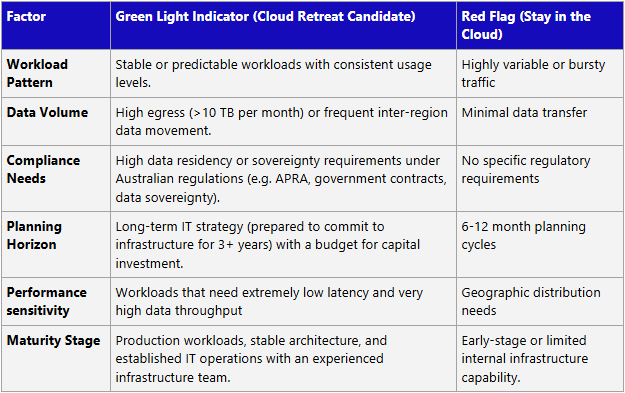
If your organisation meets four or more green light indicators, you’re likely well-positioned for a successful cloud retreat, with potential ROI realised within 24 to 36 months. If you have fewer green light indicators, you’re better off prioritising optimisation and governance before committing to migration.
The matrix provides a clear, quantifiable framework to assess readiness for cloud repatriation. It ensures any decision to leave the cloud is driven by a genuine organisational need, rather than market trends or cost anxiety.
When public cloud still makes sense
Not every organisation should pursue a cloud retreat. Public cloud isn’t going anywhere. And there’s still a very large seat for it at the IT infrastructure table. Why? Because for many use cases, public cloud remains the most practical and cost-effective option.
Workloads with highly variable or unpredictable traffic patterns still benefit from the elasticity of public cloud environments. The ability to scale up or down instantly allows organisations to meet demand surges without committing to permanent infrastructure.
Public cloud’s minimal upfront investment and pay-as-you-go model is ideal for small organisations or early-stage startups. Beyond costs, public cloud also lets these organisations focus on product development rather than infrastructure management.
Public cloud also makes sense for applications requiring true global reach. When users are distributed across multiple continents, replicating such geographic redundancy with on-premise or private infrastructure would be prohibitively expensive and operationally complex.
Specialised managed services such as AI and machine learning platforms, advanced analytics, and large-scale serverless compute remain areas where global cloud providers deliver unique value. Replicating these capabilities on local infrastructure, at a comparable performance or cost, can be impractical.
Even for organisations exploring cloud-to-on-premise migration, development and testing environments often stay in the public cloud. This hybrid approach allows teams to innovate and iterate quickly while maintaining production workloads on controlled infrastructure.
Building your cloud exit strategy: The 4-Phase Australian cloud exit framework
So, you’ve decided to make the move. What now? A successful cloud exit strategy requires structure, patience, and validation at every stage. The 4-Phase Australian Cloud Exit Framework provides a proven roadmap for organisations planning a reverse cloud migration or cloud-to-on-premise transition.
Phase 1: Assessment and discovery (2–4 weeks)
The first phase of a cloud exit strategy focuses on visibility and validation. Begin by conducting a complete inventory of all workloads, applications, and their interdependencies. This establishes a clear picture of what currently runs in the cloud and how each component connects to others.
Next, map all data sovereignty and compliance obligations, including APRA requirements for regulated financial institutions, PSPF controls for government and contractors, and the Australian Privacy Principles (APPs) for personal data handling. This step ensures that any migration plan aligns with legal and regulatory standards.
Calculate the true total cost of ownership (TCO) by accounting for hidden expenses such as egress fees, API call volume, and premium support charges. These often reveal the real financial impact of cloud operations and help build a strong business case for migration.
Finally, identify quick-win workloads suitable for a pilot migration. Ideal candidates are low-risk but high-value. Think systems that demonstrate measurable savings or performance improvements without disrupting production. This initial proof of concept sets the foundation for the next phase and reduces risk by validating assumptions early.
Phase 2: Strategic planning (4–6 weeks)
With discovery complete, the next phase focuses on designing the target environment and setting a clear financial and operational roadmap. Begin by selecting the right infrastructure model based on business priorities and workload profiles. Options typically include private cloud for maximum control, hybrid for flexibility, or co-location for cost efficiency with shared infrastructure.
Next, design a network connectivity that supports both performance and resilience. Consider using MPLS for dedicated links, Direct Connect for secure integration with any remaining cloud services, or SD-WAN for agile, cost-effective routing between sites.
Develop a three-year financial model that focuses on cost stability in Australian dollars. This model should incorporate hardware lifecycle costs, power and cooling, connectivity, and staffing—providing a transparent comparison against current cloud expenses.
Finally, establish a risk mitigation and rollback strategy. That includes defining clear checkpoints for testing, validation, and fallback to cloud environments if required. A robust plan safeguards operations during transition and also builds executive confidence in the overall cloud exit strategy.
Phase 3: Pilot migration (1–2 months)
The pilot phase transforms planning into proof. For your pilot, select a low-risk but high-value workload that can demonstrate clear business benefits without jeopardising production systems. The workload you select should offer measurable outcomes—such as improved performance, cost reduction, or compliance assurance—that you can compare directly with its cloud-based counterpart.
Once migrated, test performance benchmarks and validate compliance requirements to ensure the new environment meets or exceeds existing standards. This includes confirming latency improvements, system reliability, and adherence to frameworks such as APRA, PSPF, and the Australian Privacy Principles.
Validate cost projections against actual spend to confirm financial assumptions made during strategic planning. This real-world data helps refine the business case for a broader rollout.
Finally, use the pilot to refine processes, tooling, and documentation. When reviewing its success, capture lessons learned on migration sequencing, network configuration, and monitoring practices. A successful pilot builds confidence across technical and executive teams, setting the foundation for a controlled, low-risk full migration.
Phase 4: Full migration rollout (6–12 months)
The final phase focuses on execution and stability. At this stage, it’s important you didn’t get caught up in the go-ahead hype, and stay the course on what should be a carefully phased migration. Start with systems proven during the pilot before progressing to more complex or critical applications. This staged approach reduces risk, ensures continuity, and allows you to identify and resolve any issues before they impact broader operations.
To avoid disruption, maintain parallel operations during the transition. Running both environments temporarily allows teams to validate performance, confirm data integrity, and ensure organisational processes can continue uninterrupted. Clear communication between IT, operations and stakeholders is essential throughout this period.
Once migration is complete, shift focus to continuous monitoring and optimisation. Track key performance indicators such as latency, resource utilisation, and total cost of ownership against initial benchmarks. Use these insights to fine-tune configurations, improve efficiency, and capture ongoing savings.
A well-structured rollout not only minimises operational risk but also ensures that the benefits of the cloud-to-on-premise migration—cost predictability, performance control, and compliance confidence—are fully realised.
Following this structured framework reduces migration risk, validates assumptions early, and delivers measurable ROI. To explore your own cloud exit strategy, contact Interactive for a tailored consultation.
In today’s post-cloud migration world, cloud retreat marks a stage of strategic maturity.
As companies like 37signals and a growing number of Australian enterprises have shown, moving from public cloud to owned infrastructure can deliver lasting advantages in cost predictability, performance optimisation, and compliance confidence.
The future is not cloud-first, but cloud-appropriate. The most competitive organisations will place each workload where it performs best, whether that’s public cloud, private infrastructure, or a hybrid mix.
Interactive’s Managed Private Cloud is built for this new reality. Designed for the high-performance workloads of the AI era, it delivers the performance and scalability of public cloud with the performance, compliance and control of Australian-owned infrastructure. For most enterprise workloads, it’s the new best fit.
Is your current cloud strategy still the right fit for your business? Book a cloud assessment call with Interactive to evaluate your readiness and discover where your workloads truly belong.