
Understanding RTO and RPO: A complete guide to cloud backup and disaster recovery
Key Takeaways
- Downtime can severely damage an organisation's reliability, resulting in transaction failures and data corruption that erodes customer trust and confidence.
- Recovery Time Objective (RTO) and Recovery Point Objective (RPO) are essential metrics that guide disaster recovery strategies, impacting downtime and data.
- To achieve optimal RTO and RPO, organisations must invest in the right infrastructure and automation, balancing costs with the need for resilience and rapid response.
Just a few minutes of downtime can undo years of reliability. In the moment, transactions fail, data becomes corrupted and operations grind to a halt. But the deeper damage unfolds later, as customers lose trust and confidence in your organisation.
Customers’ reliance on digital channels is greater than ever. According to Publicis Sapient’s Digital Commerce Survey 2024, 53% of customers would consider switching brands or services due to a poor digital experience. When customers expect to do everything digitally, uptime is crucial. There’s no point investing in a world-class experience if no one can make it through the front door. That’s why having a disaster recovery strategy in place is more important than ever.
The objectives that underpin your disaster recovery strategy are Recovery Time Objective (RTO) and Recovery Point Objective (RPO). They define how fast you recover and how much data you can afford to lose, which are the two metrics that drive every disaster recovery decision. This guide breaks down RTO and RPO in plain terms, and shows you how to align them with the right infrastructure and cloud backup solutions to keep downtime and data loss under control.
What is RTO (Recovery Time Objective)?
First, let’s unpack Recovery Time Objective (RTO). RTO is the maximum amount of time your systems can be offline before the impact becomes unacceptable. In simple terms, it answers the question: “How long can we afford to be down?”
Depending on their role in your organisation, different systems will have different RTOs. For example, a payroll system can wait a few hours (even on payday), but a payment gateway can’t.
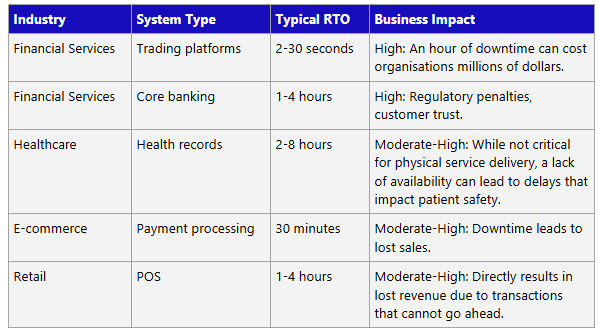
To further illustrate the point, here are a few function and industry-specific RTO benchmark examples:
- E-commerce site: 30 minutes. Every minute of downtime means lost sales. As customers are forced to go elsewhere, the impact could be long term.
- Payment processing system: 1 hour. Delays beyond that window risk chargebacks, lost transactions, and customer dissatisfaction.
- HR or internal admin system: 24 hours. Downtime is inconvenient, but not critical to operations.
Industry RTO benchmarks
The shorter your RTO target, the faster your recovery systems will need to be. And it’s best not left to chance. Achieving predictable reductions in RTO requires investment in infrastructure, automation, and redundancy. With all this in mind, RTO is as much a business decision as a technical one.
How to calculate your RTO
Determining the right RTO starts with understanding the true cost of downtime, in terms of lost revenue, compliance exposure and customer trust.
Revenue: Divide annual revenue by operational hours. Example: $10M ÷ 2,000 hours = $5,000/hour in potential loss.
Assess regulatory requirements: Some industries (like finance or healthcare) have strict maximum downtimes. If these apply, your RTO should give you some breathing room, with the aim to bring you online well before the regulator’s window closes.
Factor in customer tolerance: Survey customers or review SLA commitments to gauge expectations.
Add reputational impact: Consider long-term churn and brand damage.
Set conservative targets: Don’t leave it until the last second. For mission-critical systems, it’s safer to aim for a lower RTO.
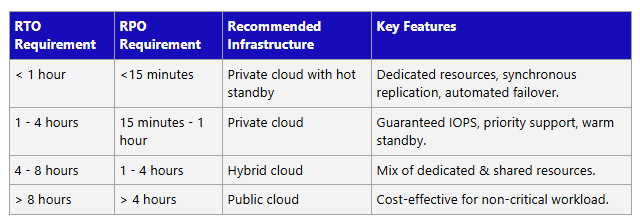
Systems with an RTO under 4 hours usually need dedicated disaster recovery infrastructure, such as those powered by private cloud services, to ensure immediate failover and minimal downtime.
What is RPO (Recovery Point Objective)?
The other piece of the disaster recovery puzzle is Recovery Point Objective (RPO). RPO defines how much data you can afford to lose during a disruption. Measured in time, not volume, RPO answers the question: “How much data can we afford to lose?”
An RPO of one hour means your organisation can tolerate losing up to one hour’s worth of data if a failure occurs. Financial transactions need a near-zero RPO to protect every transaction record, since outages rarely happen when nothing’s happening. On the other end of the scale, analytics platforms or archived documents can often withstand longer recovery windows without major impact.
Industry RPO standards
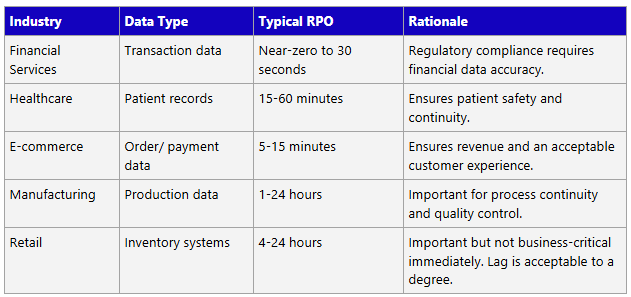
These benchmarks show how RPO expectations vary with the system’s organisational impact. The tighter the tolerance for data loss, the more advanced your RPO disaster recovery setup must be.
How to determine your RPO
Start with data change frequency, loss impact, and regulatory requirements.
Identify data change frequency: How often is new data created or updated?
Calculate impact of data loss: What’s the cost or risk of losing X hours of data?
Review compliance requirements: Some sectors mandate maximum data recovery windows.
Factor in operational complexity: How difficult is it to manually restore what’s lost?
RPO targets under 15 minutes demand continuous data replication. That means a high-performance storage layer, dedicated bandwidth, and real-time synchronisation between production and recovery sites. Anything less, and your recovery point won’t match your promise.
RPO vs RTO: Understanding the key differences
Both metrics define your recovery strategy, but they measure different things. RTO (Recovery Time Objective) defines your downtime tolerance, or how long your systems can be offline before the impact becomes unacceptable. RPO (Recovery Point Objective) defines your data loss tolerance, or how much data you can afford to lose before recovery becomes too costly or disruptive.
They’re different sides of the same coin. RTO looks forward (how fast you can restore operations), while RPO looks backward (how fresh your last backup is).
This table will help you understand the unique roles RTO and RPO play in your business continuity and disaster recovery strategy.
Comparing RTO and RPO
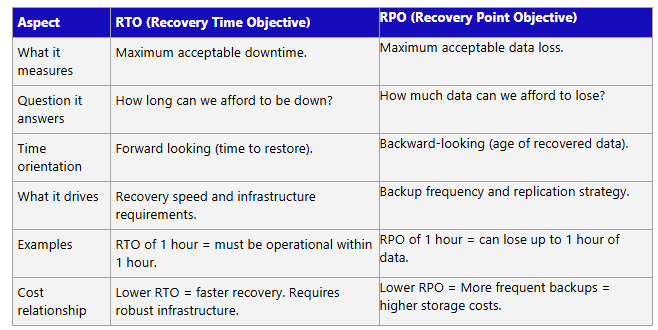
A common misconception is that good backups guarantee fast recovery. In reality, backups only preserve data — disaster recovery determines how quickly you can restore it.
For example, if an e-commerce store’s website breaks, a backup can restore the site to the exact moment before the outage. However, the store owner needs to restore the backup, reinstall the theme, reconnect the payment gateway and test the checkout before reopening, significantly delaying recovery. In this case, RPO was low (little to no data loss), but RTO was high, with the resulting downtime impacting revenue.
Now consider the reverse scenario: An accounting firm’s IT systems fail at 4pm during tax season. Their IT provider restores the service within an hour using their most recent backup. However, that backup was from the previous night, meaning almost a day’s worth of work is lost. In this case, RTO was low (fast recovery), but RPO was high, with the resulting data loss impacting productivity.
How low can you go? Balancing continuity and cost
When it comes to disaster recovery, the lower the better. But achieving lower RPOs and RTOs will come at a cost: more automation, replication, and dedicated infrastructure. As an example, the infrastructure investment required to reduce RTO from 24 hours to 4 hours can increase infrastructure costs by 30–50%. Pushing the RTO from 4 hours to 1 hour can double that again. Near-zero RPOs, using synchronous replication, can double total storage and network costs when compared to hourly backups.
In reality, most organisations don’t have the budget to address every risk. Boards and finance teams expect you to strike the right balance between requirements, risk appetite, and budget. So, determining your RPO and RTO is where strategy meets realism. And it starts with knowing the right infrastructure mix.
Infrastructure decision mix
Getting started with RTO and RPO planning
Your RTO and RPO define every decision in your cloud disaster recovery strategy. They set the boundaries for downtime and data loss, and guide where to invest in resilience. Start by calculating your targets for each critical system, then match them with infrastructure that can deliver. Don’t wait for an outage to test your plan — make sure your recovery targets are aligned, and achievable when it counts.
If slow recovery isn’t an option, Interactive’s private cloud backup provides guaranteed performance, dedicated resources, and predictable resilience.
If you’d like expert advice on your business continuity and disaster recovery planning, Interactive’s expert team can help. We’ll meet you wherever you’re at — from assessing whether your current infrastructure can meet your recovery objectives, to defining achievable RTO and RPO targets and ensuring they’re delivered cost-effectively.
Ready to make resilience predictable? To book an infrastructure or disaster recovery readiness assessment, get in touch with our team.