AI data centres: where should you host AI hardware?
Key Takeaways
- Australian organisations face pressure to utilise AI-native hardware effectively.
- AI hardware demands significant power, cooling, space and redundancy. Data centres built for pre-AI systems are often insufficient.
- Colocation facilities offer secure, high-performance environments for AI workloads, so you can maximise the value of your AI hardware.
So you’ve got your hands on AI-native hardware. What happens next? That’s the question many Australian organisations need to answer right now – often with pressure from leadership to make the most of what is a significant future-proofing investment.
“Move now, figure it out later” was the mindset as organisations rushed to get their hands on AI-capable hardware. That made sense in 2025, when the task at hand was to get ahead of a demand-driven spike in memory costs and supply-driven lead time blowout.
But later has arrived. With it, so has the pressure to get these expensive AI environments running and delivering value.
The problem? Most pre-AI on-prem data centres may not support the demands of AI hardware – at least not optimally. AI hardware demands conditions that most corporate data centres weren’t built to handle. This spans power, cooling, redundancy and the data centre’s physical layout. This creates a critical fork in your technology roadmap.
Do you invest in a new or improved on-prem data centre, or should you turn to a third-party data centre?
That’s your decision to make. Both options are viable, and Interactive supports organisations along either path. Our data centres offer high-performance, secure colocation facilities – an ideal home for locally hosted AI workloads. But for organisations that maintain their own on-prem data centre, our hardware maintenance solutions offer a reliable, cost-effective alternative to vendor or self-support.
But regardless of your long-term decision, if you’ve bought AI hardware, the fastest path to ROI right now is hosting it in a dedicated, AI-capable colocation facility.
Colocation is the plug-and-play solution that ensures you can get your AI workloads up and running quickly and effectively. It provides a secure, reliable environment without the time, cost and complexity of building or retrofitting your own facility.
But if (at least some of) your organisation’s data is among the 83% that remains on-premises, we get the apprehension. Over the years, you’ve invested heavily in maintaining a secure, compliant on-prem data centre that ensures your IT systems perform at their best. Purchasing AI hardware is simply the next step in your commitment.
If your data centre hasn’t been completely redesigned to meet the specific needs of AI hardware, it won’t be sufficient to power it. Even if an AI-native retrofit is on the cards for your organisation, it shouldn’t delay making use of your new hardware.
Hosting AI hardware in an AI-native facility doesn’t have to mean retiring your on-prem data centre. In fact, by preventing the complications of AI-driven tech debt, it might even be what makes on-prem viable long-term.
So, what exactly do workloads demand? Here’s a rundown.
What’s in an AI data centre?
Approaching megawatts: AI hardware’s power requirements.
Traditional enterprise racks were built to support 5-10kW. AI is much more power hungry. Take the evolution of NVIDIA GPUs as an example. Their A100 range, released in 2020 and now the entry-level tier for enterprise AI deployment, require 25kW density to run reliably. So, if even today’s basic AI workloads struggle on enterprise hardware what about what’s coming?
NVIDIA’s 2025 release, the GB200 NVL72 rack, needs up to 132 kW under full load. These requirements will keep going up, with the next-generation VR200 NVL72 demanding up to 230kW per rack, and up to 370Kw for high-density CPX variants. It won’t be long before we see flagship AI racks that need 1MW of power.
From CRAC to liquid – cooling for AI data centres
Cooling has become one of the biggest bottlenecks in AI data centres. Traditional Computer Room Air Conditioning (CRAC) units struggle cooling any servers taking more than 15kW of power. What can do the job? The next generation of data centre cooling is liquid cooling, which works by circulating liquid coolant directly to the chip. At the highest end of density, some facilities, Including Interactive’s data centres, go a step further with immersion cooling, which involves submerging hardware directly in coolant, non-conductive, dielectric fluid.
Your pre-AI redundancy is now redundant
Redundancy is a critical part of data centres. But whatever redundancy infrastructure you have in place, prepare for AI to expose its limits. AI demands backup solutions (generator, N+1 OR N2 redundancy) sized for a bigger load. But that’s not all: those redundancy measures also need to kick in faster – because the window before failure becomes damage has shrunk from minutes to seconds.
Physical space
This is the big one – literally. Your server room may well have the power, cooling and redundancy requirements to meet your AI hardware’s demands. But having the space for the hardware itself is a different story. An AI-capable rack can weigh well over a tonne, comfortably exceeding the 900-1,135kg per rack that most existing data centre floors are rated to support. Add the cooling hardware that comes with it, manifolds, coolant distribution units and the extra clearance liquid cooling needs, and you’re often looking at structural reinforcement or a dedicated slab, not just an empty spot on the floor.
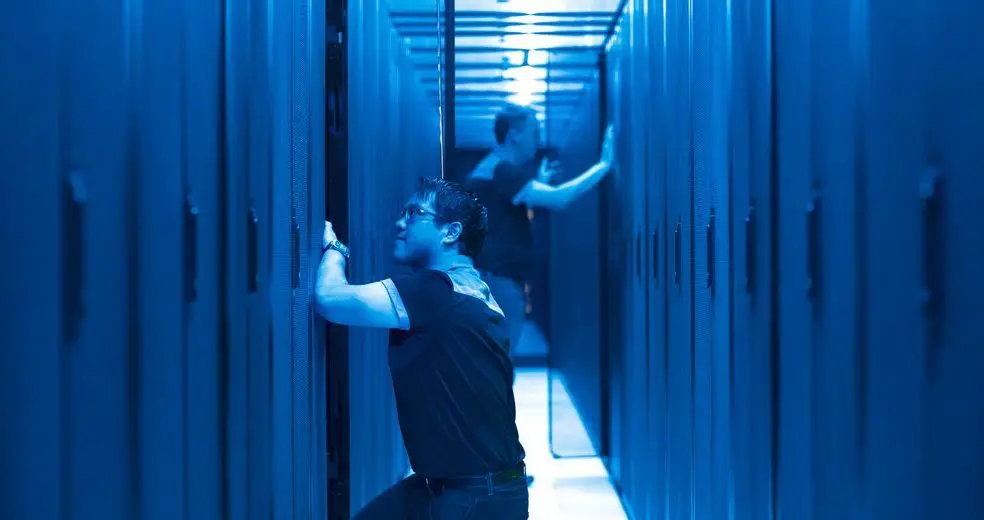
Colocation at an AI-ready data centre facility, such as Interactive’s data centres in Melbourne, Sydney and Brisbane, ticks all these boxes, so you can start getting value out of your AI hardware from day one.
The OpEx reality
For organisations all-in on on-premises hardware, colocation can seem like an admission of defeat. After all, a physical data centre means you avoid the ongoing OpEx (and a dependency on it) that comes with cloud or third-party facilities.
But it doesn’t have to be be either-or. Colocation not only protects your hardware investment in the short term, but avoids the hidden costs of an “on-prem or nowhere” mentality. Even in an on-premises environment, most organisations lack the skills and/or budget to effectively resource their infrastructure team 24/7. It’s why organisations are outsourcing support for their on-prem data centre. And the higher demands of AI hardware will create an even greater need for specialised data centre support.
To run AI hardware effectively, some form of OpEx is inevitable. Starting your AI hardware journey in a colocated facility simply ensures that the OpEx you’re spending actually delivers capability.
Stay in control of your long-term technology decisions
As AI moves from a nice-to-have to a necessity, an investment in AI hardware is an investment in the future of your organisation. It’s a significant investment too, so it shouldn’t sit idle or underperforming.
Interactive’s colocation facilities – available in Melbourne (Port Melbourne). Sydney (St Leonards) and Brisbane (Eight Mile Plains) make for an ideal home for your new AI hardware. With reliable power, liquid immersion cooling and network support, our high-performance facilities are designed for today’s, and tomorrow’s, most demanding technologies.
You won’t need to compromise on security either. Our facilities are certified to meet regulatory compliance requirements, including: ISO 9001, ISO 27001 and SOC 2.
The facilities are staffed 24/7 for uncompromising security, and you retain complete visibility and control of access. And of course, our skilled team of data centre management experts are onsite and available to offer smart hands and remote hands support.
If you’ve got an AI-ready data centre, but need a skilled team to keep your hardware running reliably, check out our hardware maintenance solutions. You’ll get access to the very team that keeps our own data centre running – meaning you’ll work with engineers who understand AI data centres.